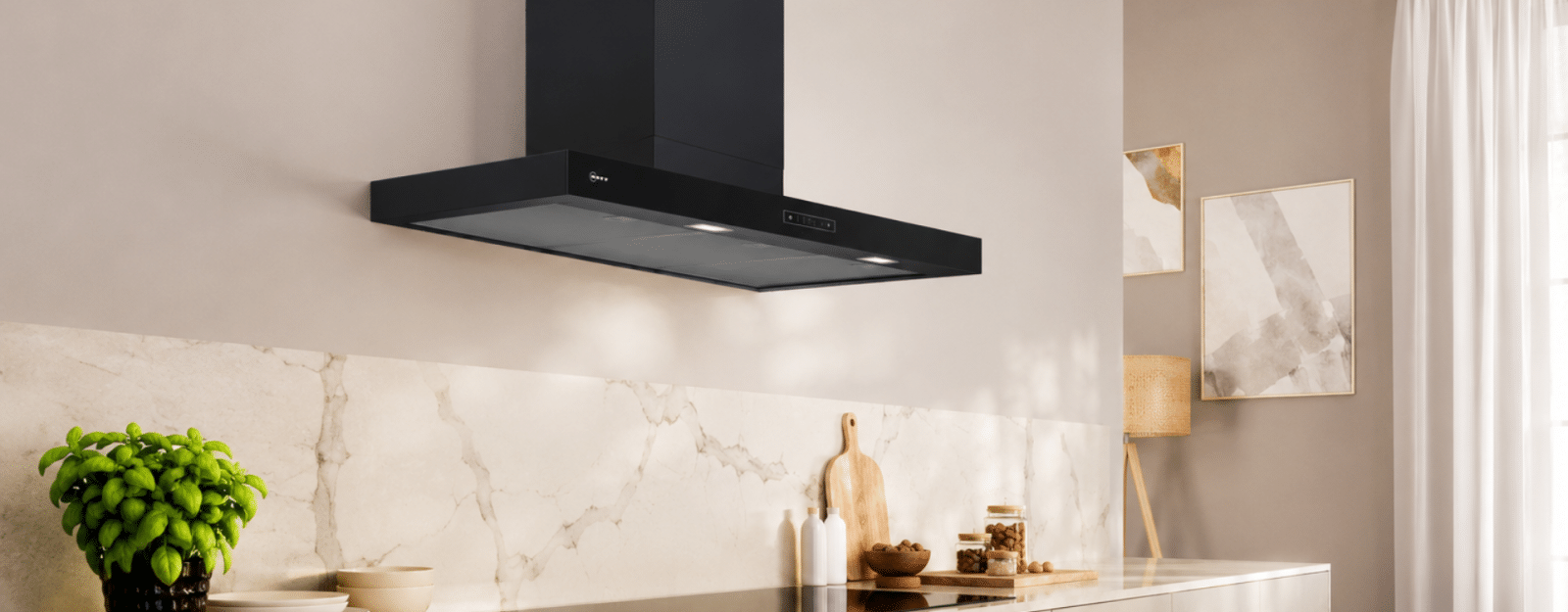
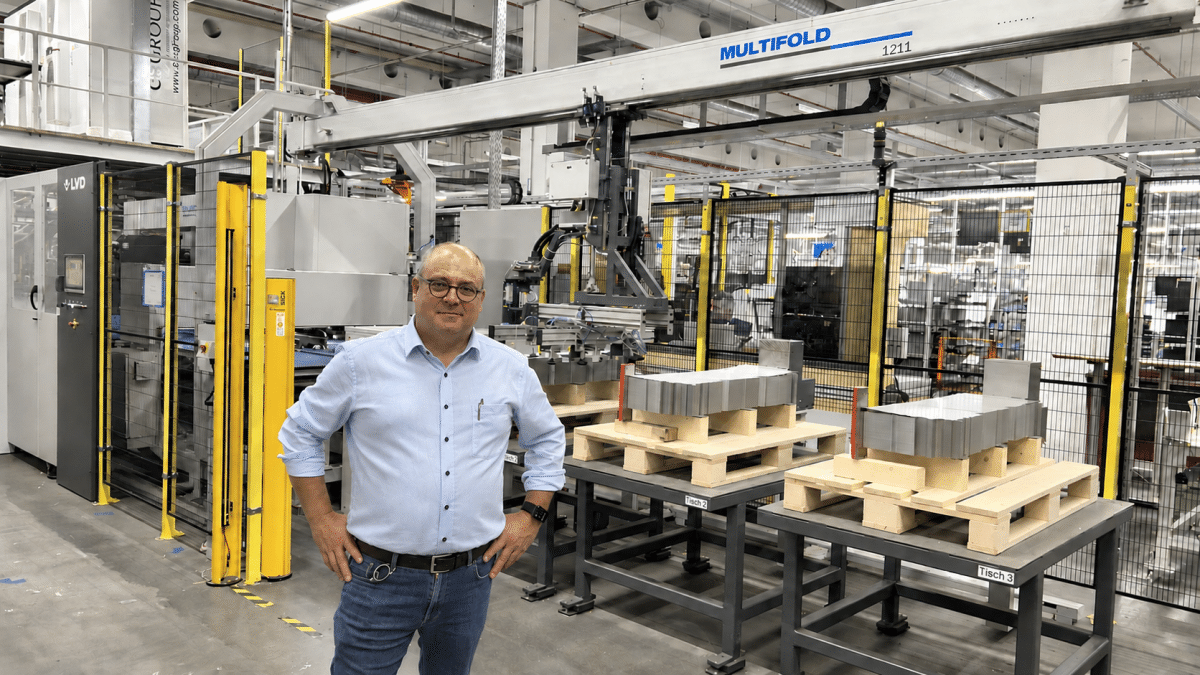
A whisper-quiet extractor hood or an oven door that disappears completely beneath the oven? These are just some of the innovations that have set German manufacturer NEFF apart for almost 150 years. The same spirit of innovation extends to its production: an LVD Multifold panel bender has been seamlessly integrated into a fully automated production line.
Since becoming part of BSH Hausgeräte GmbH in the early 1980s, NEFF has focused on manufacturing high-tech built-in ovens and extractor hoods. Around 300,000 ovens and 600,000 extractor hoods roll off its production lines every year.
Hundreds of variants
Jürgen Frank, responsible for production planning at NEFF Ventilation, explains: “A stream divides our factory into two areas. On one side, we manufacture ovens. On the other is the pre-assembly area for the extractor hoods, along with the assembly lines where the finished appliances are produced.”
“The range comprises around 470 different extractor hoods, from wall-mounted and ceiling models to integrated solutions for kitchen cabinets and downdraft extraction systems.”
“In the past, parts were manufactured in different locations, temporarily stored and assembled at a later stage. This involved a great deal of internal transport and additional handling, as well as extensive coordination between departments.”
NEFF therefore decided to take a completely different approach to producing its box-shaped wall-mounted hoods in the mid-range segment.
“The new coil-coated material we use has no protective film and is therefore particularly sensitive to scratches and handling marks. By bringing every stage – from sheet metal to finished product – together in one continuous production line, we can monitor the entire process, identify deviations at an early stage and prevent rejects.”
Choosing Multifold
“When I saw the LVD panel bender at Blechexpo 2023 in Stuttgart, I immediately thought: this could be the solution. The Multifold combined compact dimensions with the functionality and precision we were looking for. Other suppliers only offered significantly larger machines, which didn’t suit either our project or our budget for producing the casings. Another important factor was the return on investment: the Multifold would pay for itself within two years.”
At the time, NEFF was already using an Easy-Form® press brake to produce parts for downdraft extraction systems. Integrated into an automated robotic bending cell, the machine ensures a precise, adaptive bending process.
“That gave us confidence. We already knew LVD. Following a demonstration at the XP Centre in Belgium, we decided, together with our colleagues, to invest in the Multifold.”
For the new application, NEFF required several specific adaptations.
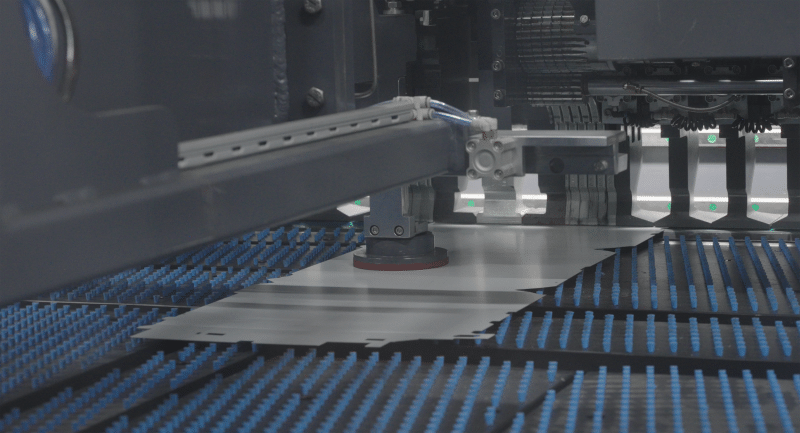
“In addition to adapting the machine to European technical standards, we requested finer brushes for the tables to ensure completely scratch-free processing.”
These brushes are now standard on the machine.
To make maximum use of the available space, the area originally intended for two loading stations was converted into three smaller areas, each accommodating 200 Euro-pallet-sized blanks.
An alternative to the LVD Multifold would have been to outsource the production of large-volume press-formed parts. However, this would have involved considerably more handling and logistics.

From India to Germany
The machine was built at LVD Multifold in India. “All communication took place via Teams. Our colleagues at Multifold walked around the machine with a camera, allowing us to follow the assembly process up close. Of course, that’s not the same as seeing the machine in person, but the open communication gave us complete confidence – both in the technology and in LVD.”
The panel bender was shipped directly from India to NEFF.
“Thanks to the careful vacuum packaging, the panel bender arrived in Germany in perfect condition after its long journey. Two colleagues from India handled the installation, after which the machine was further optimised together with LVD.”
Seamlessly integrated
The Italian systems integrator QS Group was responsible for the entire pre-assembly line, including the seamless integration of the Multifold panel bender.
Jürgen sums up the process simply: “An extractor hood essentially consists of two parts: the visible hood and the casing, which covers the fan and the exhaust air duct.
“A black or stainless-steel-coloured sheet is automatically picked up from one of the three loading stations. To save cycle time, the sheet is centred separately from the main bending process. The Multifold then folds the edges of the casing before the part is conveyed to a QS Group machine, where it is formed into a U-shape.”
Thirteen casings are then buffered on each of two conveyor belts – one for black parts and one for stainless steel-coloured parts. The belts compensate for any variations in cycle time between the Multifold and the rest of the line.
“In the penultimate step, the casing is joined to the visible hood at what we call the ‘marriage station’. From there, it moves to two in-line assembly conveyors, where the internal components are fitted. The finished product is then inspected, labelled and packed before being transported by AGV to the central BSH warehouse.”
Every second counts – and so does quality
“With the new production line, we have virtually eliminated extra transport, intermediate storage and handling. The Multifold plays a key role in this. At the same time, we can continuously monitor the entire process and ensure the required level of precision. That was exactly our goal.”
Watch the testimonial
Company NEFF
Since 1877
Industry: Built-in kitchen appliances
Works with: Stainless steel, coil-coated steel
LVD Installations:
- Easy-Form® 110/42 press brake
- Multifold 1211 panel bender
LVD Software: CADMAN-B
Website: www.neff-home.com